The Importance of Strong Branding in the Digital Era
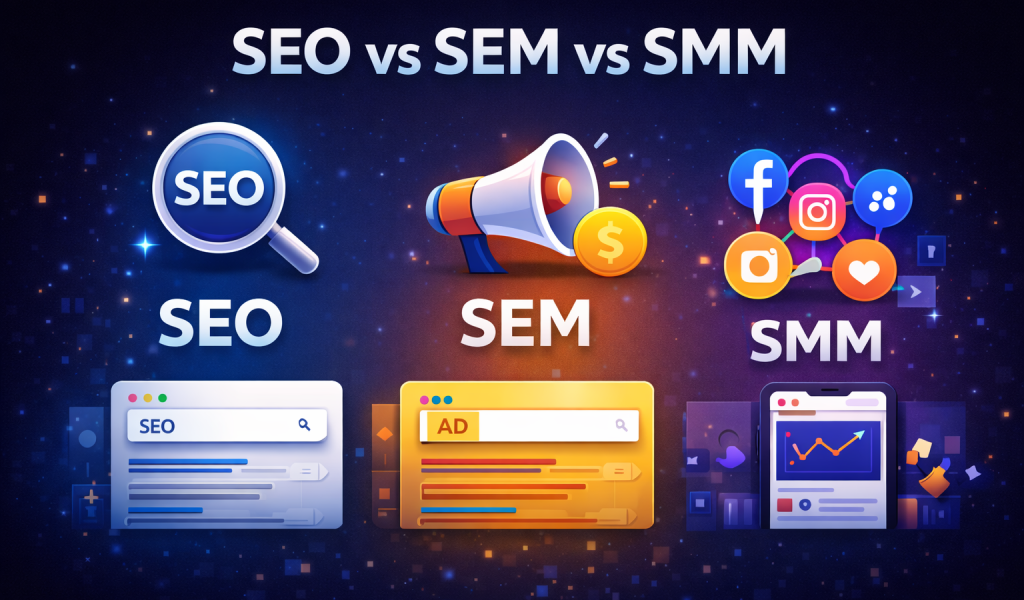
In the world of digital marketing, businesses often hear terms like SEO, SEM, and SMM. While these strategies are closely related, they serve different purposes and work together to build a strong online presence.
Understanding how these marketing methods work can help businesses choose the right strategy for their growth goals. For companies targeting competitive markets such as the UK, USA, and Europe, using the right combination of these strategies can significantly increase traffic, leads, and sales.
This article explains what SEO, SEM, and SMM are, how they differ, and how businesses can use them effectively.
Search Engine Optimization (SEO) refers to the process of improving a website’s visibility in search engine results pages such as Google.
When people search for information online, they usually click on results that appear at the top of the page. SEO helps websites rank higher in these results without paying for advertising.
SEO includes several important components:
Keyword research involves identifying the terms people use when searching for products or services online.
For example, someone searching for digital marketing services may type:
Targeting the right keywords helps businesses attract relevant traffic.
On-page SEO focuses on optimizing the content and structure of web pages. This includes:
Proper on-page optimization helps search engines understand what a page is about.
Technical SEO ensures that a website is easy for search engines to crawl and index.
Important technical factors include:
A technically optimized website performs better in search rankings.
Search Engine Marketing (SEM) refers to paid advertising on search engines.
The most popular SEM platform is Google Ads, where businesses can create ads that appear at the top of search results.
Unlike SEO, which takes time to generate results, SEM can bring traffic immediately.
Businesses choose keywords they want to target and create advertisements related to those keywords.
When users search for those keywords, the ads appear above organic search results.
Advertisers typically pay each time someone clicks on their ad. This model is called Pay-Per-Click (PPC) advertising.
SEM offers several advantages:
This makes SEM ideal for businesses that want quick traffic and immediate lead generation.
Social Media Marketing (SMM) involves promoting products or services through social media platforms such as:
SMM focuses on building relationships with audiences and increasing brand awareness.
Organic SMM includes creating and sharing content that engages followers. Examples include:
Consistent posting helps businesses build trust and credibility with their audience.
Social media platforms also offer advanced advertising options.
Businesses can target audiences based on factors such as:
This level of targeting allows businesses to reach highly specific audiences.
Although these strategies all aim to attract customers online, they differ in several ways.
SEO typically takes longer to show results because it focuses on organic rankings. However, once rankings improve, traffic can continue for a long time.
SEM provides immediate visibility but requires continuous advertising budgets.
SMM can generate both short-term and long-term benefits depending on how campaigns are managed.
SEO primarily requires investment in time, content creation, and optimization.
SEM involves paying for advertising clicks.
SMM can include both organic content creation and paid advertising campaigns.
SEO focuses on capturing search intent when users actively search for information.
SEM targets users who are already searching for related products or services.
SMM focuses more on engagement and relationship building with audiences.
The most effective digital marketing strategies often combine all three approaches.
For example:
Using these strategies together allows businesses to reach customers at different stages of their buying journey.
SEO, SEM, and SMM are essential components of a successful digital marketing strategy.
While each method has its own strengths, combining them creates a balanced approach that drives both short-term results and long-term growth.
Businesses that invest in these strategies will be better positioned to compete in the digital marketplace.

Youngsteck.ai is an AI-powered digital solutions company helping businesses grow through smart technology and innovative strategies. We specialize in web development, digital marketing, SEO, SEM, SMM, and graphic design, combining human expertise with advanced AI tools to deliver faster, smarter, and more effective results.
+44 786 871 1165
support@youngsteck.ai
124 City Road, London, EC1V 2NX
© Copyright 2026 | Youngs Teck | All Rights Reserved.