The Importance of Strong Branding in the Digital Era
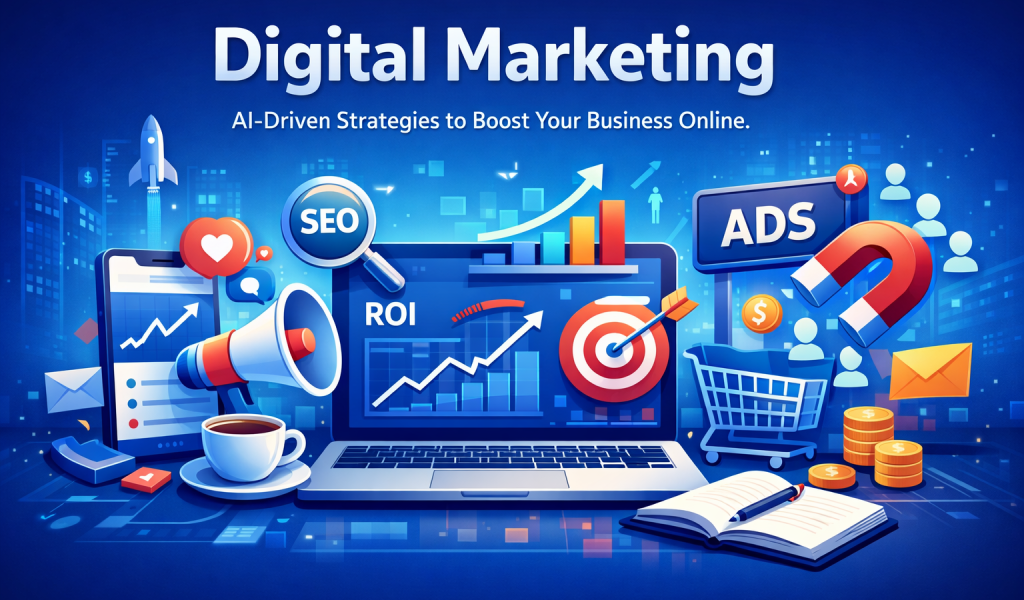
Digital marketing has evolved dramatically over the past decade. Businesses that once relied on traditional marketing strategies now operate in a highly competitive online environment. Search engines, social media platforms, and online advertising have completely changed how companies reach customers.
One of the most significant developments shaping this new landscape is Artificial Intelligence (AI). AI is transforming how businesses analyze data, create marketing strategies, and interact with their audiences.
For companies aiming to stay competitive in markets such as the UK, USA, and Europe, AI-driven digital marketing is no longer a luxury—it has become a necessity.
Artificial intelligence refers to systems that can analyze data, learn patterns, and make decisions with minimal human intervention.
In digital marketing, AI helps businesses understand customer behavior by analyzing large volumes of information. This includes website visits, search queries, social media engagement, and purchasing habits.
Instead of manually studying this data, AI tools can process it quickly and provide insights that guide smarter marketing decisions.
This allows companies to build more effective strategies that target the right audience with the right message.
One of the biggest advantages of AI in marketing is its ability to analyze massive amounts of data.
Businesses today collect enormous amounts of information from:
AI-powered tools analyze these datasets to identify trends and patterns.
For example, AI can determine:
This information allows businesses to allocate resources more efficiently and improve campaign performance.
Personalization has become one of the most important elements of modern marketing.
Customers expect brands to deliver experiences tailored to their preferences.
AI makes this possible by analyzing individual behavior.
For example, AI systems can recommend products based on previous purchases, browsing behavior, or customer interests.
E-commerce companies like Amazon and Netflix have used AI personalization successfully for years. Now, businesses of all sizes can use similar technology to improve customer engagement.
Personalized marketing messages increase the chances that customers will interact with content, click on advertisements, and complete purchases.
Search engine optimization remains one of the most powerful long-term marketing strategies.
AI is significantly improving how SEO strategies are developed.
AI tools can now analyze search engine algorithms and user behavior to identify:
These tools also help businesses optimize their content for search intent.
Instead of simply targeting keywords, marketers can create content that answers specific questions users are searching for online.
This approach increases the chances of ranking higher in search engine results.
Another major benefit of AI is automation.
Marketing teams often spend a large amount of time performing repetitive tasks, such as:
AI-powered automation tools can perform these tasks automatically.
For example, email marketing systems can send personalized messages based on customer actions. If a visitor abandons a shopping cart, the system can automatically send a reminder email.
Automation improves efficiency and allows marketers to focus on strategy and creativity.
Online advertising platforms such as Google Ads and Facebook Ads now rely heavily on AI algorithms.
These algorithms analyze user behavior and automatically adjust advertising campaigns.
AI can optimize:
This ensures that advertisements are shown to users who are most likely to convert.
As a result, businesses can achieve better results while spending their advertising budgets more efficiently.
Customer support is another area where AI is making a significant difference.
AI-powered chatbots can interact with website visitors and answer common questions instantly.
These systems operate 24 hours a day, providing immediate responses even outside of normal business hours.
Chatbots can assist customers with:
By handling routine inquiries, chatbots free up human support teams to focus on more complex issues.
Despite its advantages, AI also presents challenges.
Businesses must ensure that AI systems are used responsibly and ethically.
Data privacy regulations such as GDPR require companies to protect user information and obtain consent before collecting personal data.
Another challenge is over-reliance on automation. While AI provides valuable insights, human creativity and emotional understanding remain essential.
Successful marketing strategies combine technology with human expertise.
The role of AI in marketing will continue to expand.
Future developments may include:
Businesses that adopt AI technologies early will be better prepared to adapt to these changes.
Artificial intelligence is transforming digital marketing in powerful ways.
From data analysis and personalization to automation and advertising optimization, AI provides tools that help businesses work smarter and achieve better results.
However, the most successful companies will be those that combine AI technology with human creativity and strategic thinking.
As the digital landscape continues to evolve, AI-driven marketing will become a key factor in long-term business success.

Youngsteck.ai is an AI-powered digital solutions company helping businesses grow through smart technology and innovative strategies. We specialize in web development, digital marketing, SEO, SEM, SMM, and graphic design, combining human expertise with advanced AI tools to deliver faster, smarter, and more effective results.
+44 786 871 1165
support@youngsteck.ai
124 City Road, London, EC1V 2NX
© Copyright 2026 | Youngs Teck | All Rights Reserved.